
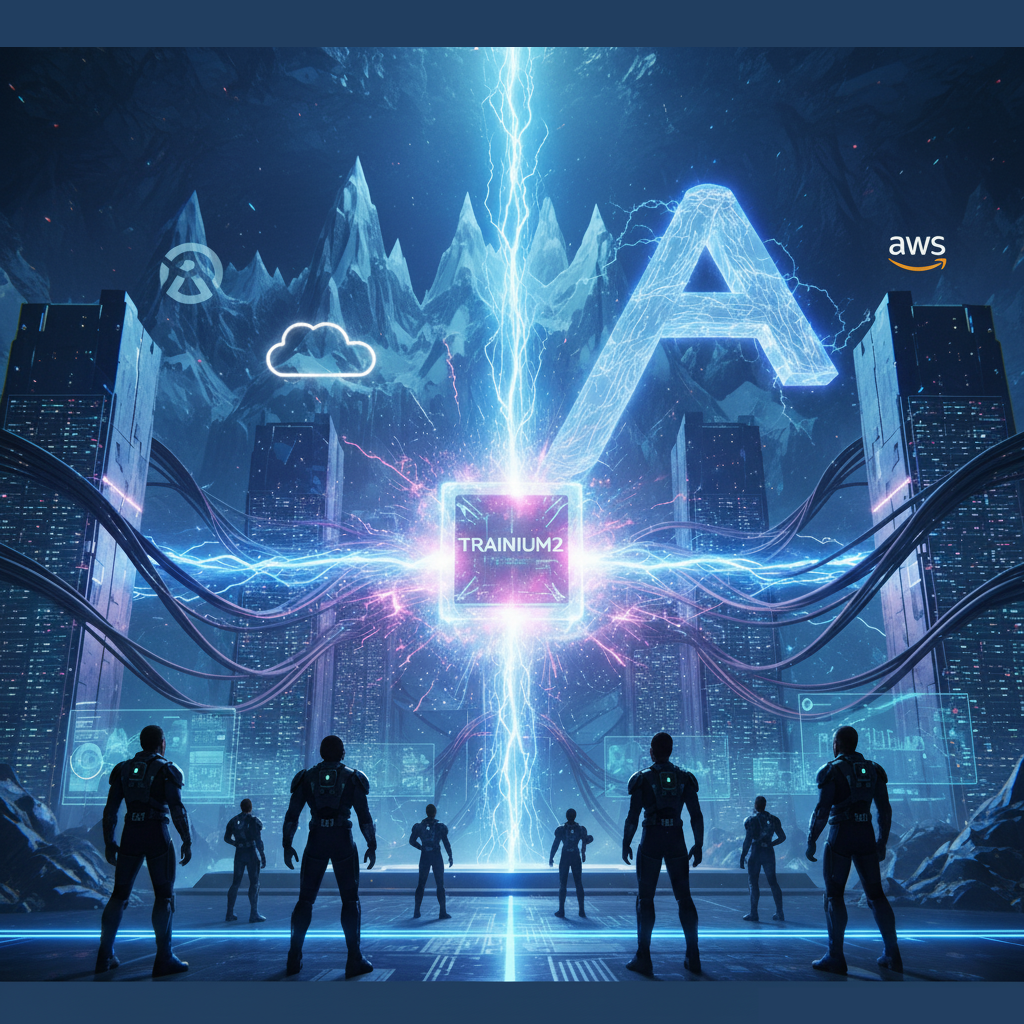
In the most significant move to date to secure its territory in the generative AI arms race, Amazon.com announced on Wednesday the official launch of “Project Rainier.” This massive, new AI compute cluster is a purpose-built supercomputer designed for one primary mission: to train and run the large-scale artificial intelligence models from its key partner, Anthropic, the creator of the Claude family of AI.
This announcement is a direct broadside against competitors like Microsoft and Google. It signals a massive acceleration in Amazon’s strategy of vertical integration, moving from a cloud provider to a full-stack AI powerhouse by combining its multi-billion-dollar investment in Anthropic with its own custom-built silicon, the Amazon Trainium2 chip. Project Rainier isn’t just a new server rack; it’s Amazon’s foundational infrastructure for the next decade of AI, and it’s built to challenge Nvidia’s market dominance head-on.
What Is Project Rainier? An AI Supercomputer is Born
Project Rainier is not a typical cloud computing service. It is a specialized, high-performance computing (HPC) cluster, effectively a dedicated AI supercomputer, built by Amazon Web Services (AWS). According to the announcement, the cluster is an AI compute powerhouse spread across multiple data centers.
The core of this new supercomputer is its processing power. While the AI world has been almost entirely dependent on GPUs from Nvidia, Project Rainier is built using nearly half-a-million of Amazon’s own in-house Trainium2 chips. These chips are “purpose-built” for high-performance, deep-learning training, optimized specifically to work within the AWS ecosystem.
By building this massive cluster, Amazon is creating a fortress for its most important AI partner. Anthropic will be the anchor tenant, using this vast new capacity to train, build, and deploy its current and, more importantly, future generations of Claude AI models. This gives Anthropic the raw compute power it needs to compete directly with OpenAI’s GPT series, while giving Amazon a premier workload to prove the power of its custom chips.
The Silicon Gambit: Why Amazon’s Trainium2 Chip is the Real Story
The launch of Project Rainier is as much about hardware as it is about AI. For years, the entire AI industry has been constrained by a single bottleneck: the availability and high cost of Nvidia’s advanced GPUs. Amazon’s answer to this problem is vertical integration.
The Amazon Trainium2 is AWS’s second-generation custom AI training chip. It is the result of billions of dollars in research and development and represents Amazon’s strategy to achieve silicon independence. By building its own chips, Amazon gains three critical advantages:
- Cost Control: Every Nvidia H100 or B200 GPU that Amazon doesn’t have to buy is a massive cost saving. By using its own Trainium2 chips at scale, Amazon can dramatically lower the operational costs of training and running massive AI models, a saving it can pass on to AWS customers (like Anthropic) to make its cloud the most affordable option.
- Supply Chain Security: The global “GPU shortage” has dictated the pace of AI development. By manufacturing its own chips, Amazon is insulating itself and its key partners from this volatile supply chain. It can build its AI infrastructure on its own terms and on its own timeline.
- Performance Optimization: Trainium2 chips are not built for general-purpose graphics; they are built for one thing: training AI models efficiently within the AWS environment. They are deeply integrated with AWS’s networking (EFA – Elastic Fabric Adapter) and its AI platform, Amazon Bedrock. This tight integration allows for superior performance on specific AI workloads compared to more generalized hardware.
Project Rainier is the first large-scale, commercial validation of this strategy. It is Amazon planting its flag and declaring that it will no longer be solely reliant on third-party hardware to power its AI ambitions.
Anthropic and Claude: The Anchor Tenant for Amazon’s AI Empire
This massive hardware investment would be useless without a world-class AI model to run on it. This is where Anthropic comes in.
In 2024, Amazon made a landmark $4 billion investment in the AI safety and research company, securing a minority stake and becoming its most important strategic partner. Project Rainier is the physical manifestation of that partnership. Anthropic, which is developing some ofthe most powerful and safest AI models on the market, has an insatiable need for compute power.
With Project Rainier, Amazon is providing that power. Anthropic will use this new cluster to:
- Train Future Models: This cluster provides the power needed to build what comes after Claude 3, likely “Claude 4” or a new successor architecture, allowing it to scale to trillions of parameters.
- Scale Deployment: As millions of users and businesses access Claude models through Amazon Bedrock (AWS’s platform for generative AI models), Rainier will provide the inference capacity to serve those requests quickly and, most importantly, cost-effectively.
Anthropic is expected to leverage more than a million of Amazon’s custom chips (including Trainium2 and its inference-focused “Inferentia” chips) across AWS by the end of the year, making it the single largest customer for Amazon’s in-house silicon.
The Great AI Cloud War: How Rainier Stacks Up
The launch of Project Rainier cannot be viewed in a vacuum. It is a direct counter-move in the “AI Cloud War” being waged between the three tech hyperscalers.
- Microsoft’s Play: Microsoft’s multi-billion dollar partnership with OpenAI set the template. Microsoft built its own AI supercomputers using Nvidia GPUs to power ChatGPT and then integrated those models deeply into its Azure cloud and Copilot products.
- Google’s Play: Google is the most vertically integrated of all. It designs its own TPUs (Tensor Processing Units), builds its own models (Gemini), and runs them on its own Google Cloud Platform (GCP).
- Amazon’s Play: Amazon, which has the largest cloud market share, was seen as being behind in the generative AI race. Its strategy is now clear: It has paired its own custom chip (Trainium2) with a leading independent AI lab (Anthropic) and is making both available on its dominant cloud platform (AWS Bedrock).
Project Rainier is Amazon’s declaration that it will compete on every level—from the silicon to the platform to the model.
Interestingly, this AI landscape is a complex web of “frenemies.” Anthropic also took hundreds of millions in funding from Amazon’s rival, Google, and its Claude models are also available on Google Cloud. This makes Amazon’s hardware advantage critical. By making it faster, cheaper, and more efficient to run Claude on AWS via Project Rainier, Amazon is creating a powerful incentive for Anthropic, and all other AI developers, to choose AWS over Google Cloud.
Conclusion: The Future is Custom-Built
Amazon’s Project Rainier is more than just a data center launch; it’s a fundamental statement about the future of technology. It proves that to compete at the highest levels of AI, companies can no longer just be consumers of technology—they must be builders of it, from the foundational silicon up.
By betting on its own Trainium2 chips, Amazon is taking a calculated risk to break the Nvidia bottleneck, control its own destiny, and secure its cloud dominance for the AI-driven era. With Anthropic’s Claude as its flagship partner, Project Rainier is the new engine at the heart of Amazon’s sprawling AI empire.
Keywords: Amazon Project Rainier, Anthropic Claude, Amazon Trainium2, AI Supercomputer, AI Cluster, Amazon Web Services, AWS AI, Generative AI, AI Infrastructure, Cloud Computing, Amazon Anthropic Investment, Trainium2 vs Nvidia, AI Arms Race, Claude 3, Amazon Bedrock.