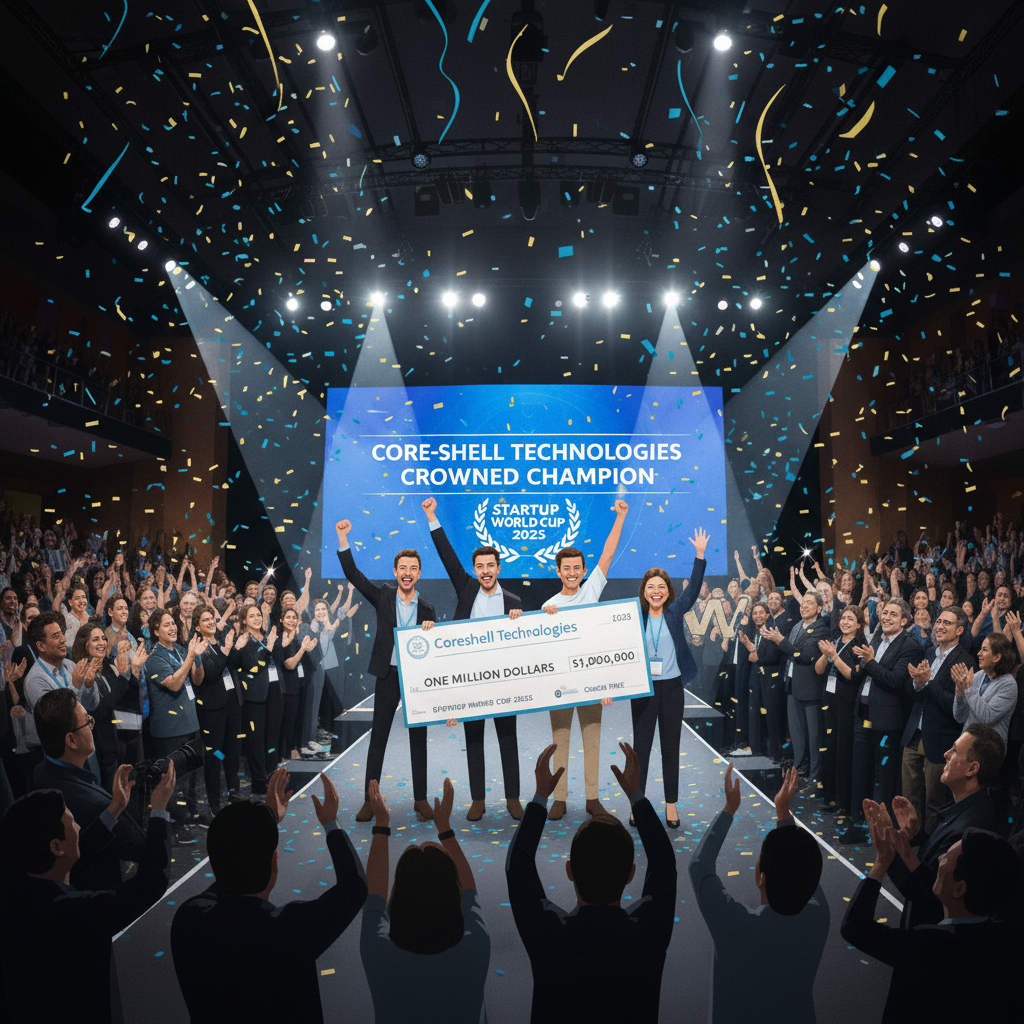
In a landmark moment for the cleantech industry, Coreshell Technologies, a US-based battery innovator, was crowned the global champion at the Startup World Cup 2025 Grand Finale, securing a $1 million investment prize. The event, held in San Francisco on October 17, saw Coreshell triumph over thousands of startups from more than 100 countries, validating its revolutionary approach to solving one of the greatest challenges in energy: building cheaper, more efficient, and scalable batteries.
This victory is more than just a financial windfall; it’s a powerful endorsement of Coreshell’s mission to decarbonize transportation and energy by unlocking the true potential of silicon.
The $1 Million Pitch: A Groundbreaking Solution to a Global Problem
The Startup World Cup, hosted by Pegasus Tech Ventures, is the largest and most prestigious global startup competition, bringing regional winners from six continents to Silicon Valley. In a high-stakes finale, Coreshell pitched its technology to a panel of top-tier venture capitalists from firms like Andreessen Horowitz, Khla Ventures, Samsung Ventures, and Salesforce Ventures.
Coreshell’s winning pitch centered on a breakthrough that could fundamentally change the economics of electric vehicles (EVs) and energy storage. The company has developed a way to use metallurgical-grade silicon as the anode material in lithium-ion batteries, replacing the graphite used in virtually all batteries today.
Jonathan Tan, Co-Founder and CEO of Coreshell, articulated a compelling vision. “We are honored and humbled by this recognition,” he stated. “Competing against thousands of incredible startups from around the world is a testament to our team’s relentless work. This prize isn’t just for Coreshell; it’s a win for scalable cleantech and a validation that the world is ready to move beyond 30-year-old battery technology.”
Why Metallurgical Silicon is a Game-Changer
To understand the significance of Coreshell’s win, one must first understand the “holy grail” of battery technology: the silicon anode.
- The Problem with Graphite: For decades, lithium-ion battery anodes have been made of graphite. While stable, graphite is a bottleneck. It has a limited energy capacity, and its supply chain is overwhelmingly concentrated, posing a significant geopolitical and cost risk.
- The Promise of Silicon: Silicon is the dream material for anodes. It’s abundant (the second most common element on Earth) and can theoretically store 10 times more energy than graphite. A successful silicon anode means an EV that can travel significantly farther on a single charge.
- The “Swelling” Challenge: The dream has always been a practical nightmare. When silicon absorbs lithium ions during charging, it swells up to 300% in volume. This expansion and contraction quickly pulverizes the silicon, causing the battery to degrade and fail after just a few cycles.
This is the problem Coreshell has solved.
Instead of using highly processed, expensive “synthetic silicon” that tries to mitigate this swelling, Coreshell takes a radically different approach. They use low-cost, abundant metallurgical-grade silicon and encapsulate it with a proprietary nanolayer coating. This flexible, conductive coating acts like a suit of armor, holding the silicon particles together as they expand and contract.
This breakthrough allows Coreshell to:
- Slash Battery Costs: Metallurgical silicon is up to 50% cheaper than graphite.
- Boost EV Range: Their technology can increase a battery’s energy density by over 30%, adding significant range to electric vehicles.
- Secure the Supply Chain: By using a material sourced globally, including in the US, it breaks reliance on graphite supply chains.
- Integrate Seamlessly: The technology is designed as a “drop-in” solution, meaning existing battery manufacturing plants can adopt it without a complete and costly retooling.
A Fierce Global Competition
Coreshell’s victory was earned against a backdrop of intense and diverse global innovation. The startup, which won its regional US competition to advance, was one of ten finalists to pitch at the Grand Finale. These finalists represented the pinnacle of global entrepreneurship:
- 2nd Place: Intuition Robotics (Israel): The creators of ElliQ, a proactive and “relationship-driven” AI companion designed to help older adults live happier, healthier, and more independent lives.
- 3rd Place: BuuPass (Kenya): A B2B and B2C mobility platform digitizing Africa’s $100 billion long-distance transport market, often described as the “Expedia for African transport.”
- Other Finalists: The field included Japan’s Acompany (confidential data computing), Taiwan’s FaceHeart (contactless AI-driven vital sign monitoring), and New Zealand’s ScentianBio (digital smell sensors using insect receptors for food quality).
“This year’s competition was incredibly fierce,” said Anis Uzzaman, Founder and CEO of Pegasus Tech Ventures and Chairman of the Startup World Cup. “Coreshell’s outstanding performance is a clear indicator of their potential to disrupt a massive and critical industry. This event proves once again that world-changing ideas can truly come from anywhere.”
What This Win Means for Coreshell and the EV Market
The $1 million investment is an accelerator, but the validation is the real prize. Coreshell, which has already been delivering its first commercial-scale 60 Ah battery cells to automakers for testing, now has a global spotlight and the backing of some of Silicon Valley’s most influential investors.
This win signals a major market shift. For years, the EV transition has been hampered by “range anxiety” and high costs. Coreshell’s technology directly addresses both. By creating a path to lower-cost, longer-range batteries, this win could be a pivotal moment in the mass-market adoption of electric vehicles, making them more affordable and practical for everyone.
Keywords: Coreshell Technologies, Startup World Cup 2025, Battery Technology, Metallurgical Silicon Anode, EV Batteries, Electric Vehicles, Cleantech, Lithium-Ion Battery, Graphite Anode, Anis Uzzaman, Pegasus Tech Ventures, $1 Million Prize, Startup Competition, Battery Innovation, Energy Storage.