Here is a long-form, SEO-friendly article based on the news.
King’s AI Warning: Charles III Delivers Personal Letter on ‘Profound Risks’ to Nvidia CEO Jensen Huang
Date News Broke: November 5, 2025
In a moment of striking symbolism that bridges the gap between ancient monarchy and exponential technology, King Charles III has delivered a personal and direct warning on the dangers of Artificial Intelligence to the man arguably most responsible for powering its explosive growth: Nvidia CEO Jensen Huang.
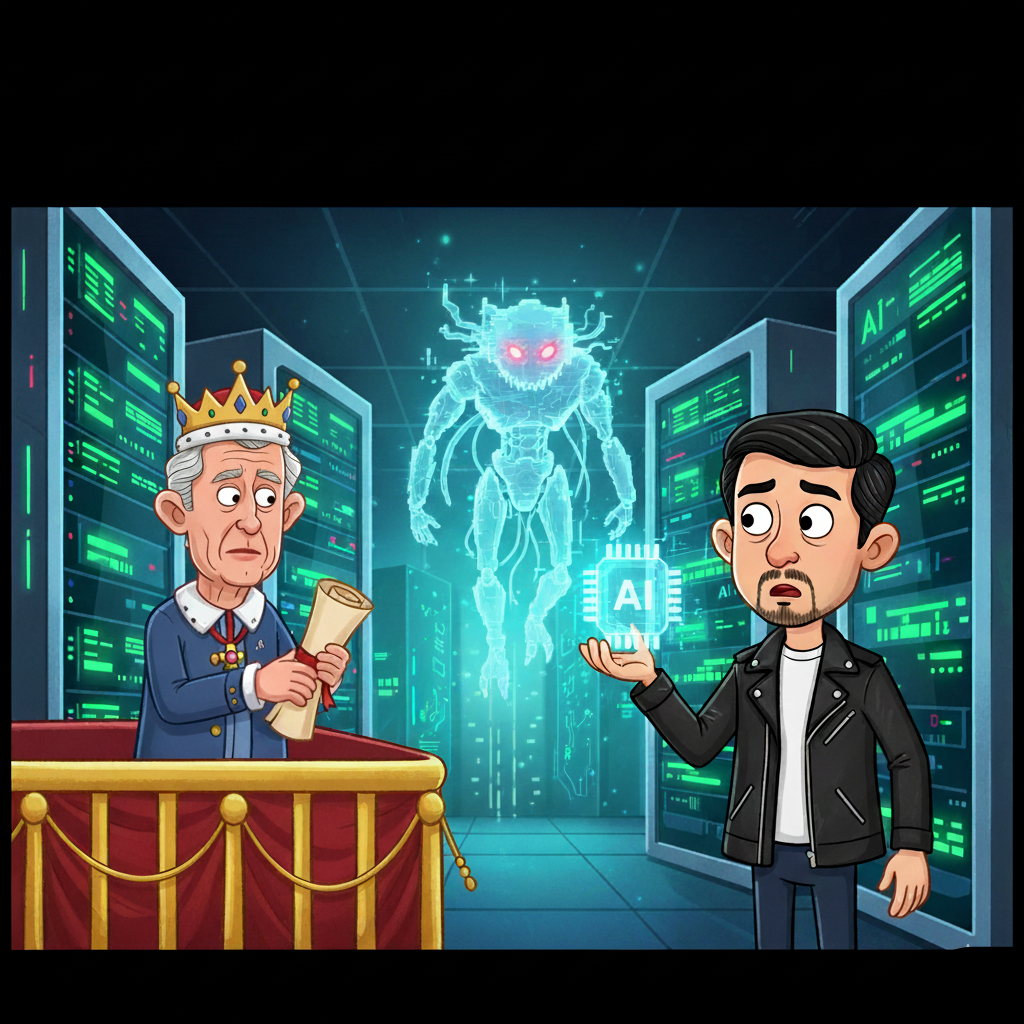
The remarkable exchange occurred at St James’s Palace during the prestigious 2025 Queen Elizabeth Prize for Engineering (QEPrize) ceremony. While presenting the award to Huang, the King handed him a sealed letter, reportedly stating with unusual urgency, “I need to talk to you.”
That letter, as Huang later confirmed, was a personal copy of the King’s landmark 2023 speech from the AI Safety Summit at Bletchley Park. It was a clear, high-profile reminder from a head of state to the leader of the world’s most valuable company that the “profound risks” of AI must be managed with “urgency, unity and collective strength.” The move has sent ripples through the tech and policy worlds, amplifying the global debate on AI safety and corporate responsibility.
An Unprecedented Encounter at the ‘Nobel Prize of Engineering’
The setting for this exchange could not have been more significant. The Queen Elizabeth Prize for Engineering, often described as the “Nobel Prize for engineering,” is a celebration of innovation that has delivered global benefit to humanity. For 2025, the prize was awarded to seven of the most foundational figures in modern machine learning.
This group included Nvidia’s Jensen Huang and Chief Scientist Bill Dally, who were honored for creating the Graphics Processing Units (GPUs) and hardware platforms that transformed AI from a theoretical concept into a practical, world-changing force. Ironically, the very tools that earned Huang this prestigious award are the same ones that power the advanced AI models at the center of the King’s concerns.
Other 2025 laureates present included the “godfathers of AI,” Yoshua Bengio, Yann LeCun, and Geoffrey Hinton, as well as AI pioneer John Hopfield and Stanford’s Dr. Fei-Fei Li, who created the seminal ImageNet dataset.
As the King presented the trophy, he singled out the Nvidia CEO. “The King, surprisingly, he reminded me that he wanted to talk to me,” Huang told reporters after the ceremony. “And as (Charles) came up to me, he said, ‘there’s something I want to talk to you (about)’ and he handed me a letter, and this is a speech on AI safety.”
The Royal Warning: A Reiteration of the Bletchley Park Speech
The letter’s contents were not new, but their delivery was a powerful symbolic act. The speech was the same one King Charles had delivered via video to world leaders and tech executives at the first-ever AI Safety Summit in 2023, held at the historic home of Britain’s wartime codebreakers.
In that speech, the King compared the rise of Artificial Intelligence to “the discovery of electricity,” noting its “extraordinary potential” but also its “profound risks.” He warned that managing this technology required an international, collaborative effort, urging leaders to tackle the challenges with “a sense of urgency, unity and collective strength” to ensure AI is developed in a way that is “safe” and “human-centric.”
By handing a physical copy of this speech directly to Jensen Huang, the King was not just making a polite gesture. He was personally and pointedly reminding the CEO whose hardware underpins nearly every major AI model—from OpenAI’s GPT-4o to Google’s Gemini—of his and his company’s central responsibility in mitigating those risks.
During a discussion with the winners, the King was even more candid, warning that “there’s a lot of bad actors around” and noting that the rate of technological emergence is “just rapid.”
Nvidia’s Response and the ‘Double-Edged Sword’
Jensen Huang, now the steward of a company with a multi-trillion-dollar valuation built on AI chips, appeared to receive the message with due gravity.
“He obviously cares very deeply about AI safety,” Huang said of the King. “He believes in the power of the technology, the incredible capability to revolutionize UK and the world, but he also wants to remind us that the technology could be used for good and for evil, and so to make sure that we do everything we can to advance AI safety.”
Huang, who has at times been bullish about the race to Artificial General Intelligence (AGI), stated that he would “read that letter thoroughly.”
The other laureates echoed this sentiment of balanced concern. Dr. Fei-Fei Li, a leading voice for human-centered AI, shared details of her own conversation with the monarch. “He’s such a friendly person and he’s obviously aware of this technology and aware of its human impact,” she said.
Dr. Li elaborated on the core tension at the heart of the event: “AI is a very powerful technology—as all powerful technologies are, they’re a double-edged sword… But also there are risks: Jobs will be shifting, it will impact different industries in very different ways, whether it’s … from deep fakes to its ability to make decisions.”
Why This Moment Matters: A Reckoning for Big Tech
This interaction is far more than a royal curiosity. It symbolizes the growing pressure on tech companies to move beyond the Silicon Valley mantra of “move fast and break things.”
- Direct Corporate Responsibility: The King’s decision to hand the letter to Huang, specifically, was a targeted act. It wasn’t given to the academics; it was given to the industrialist—the man who builds and sells the “picks and shovels” of the AI gold rush. The message is clear: the makers of the hardware are just as responsible for its use as the creators of the software.
- Global Leadership is Watching: This act elevates the AI safety debate from tech blogs and academic papers to the level of heads of state. King Charles, who has used his platform for decades to warn about climate change, is now applying that same moral weight to the risks of AI.
- The ‘Godfathers’ Dilemma: The presence of Geoffrey Hinton and Yoshua Bengio was particularly poignant. Both have become outspoken critics of the technology they helped create, warning of existential risks. Honoring them for their innovation while simultaneously discussing the dangers of that innovation captures the profound anxiety of the current moment.
The King’s gesture was a masterful piece of “soft power” diplomacy, a public and personal appeal for caution and conscience from the very individual enabling the AI revolution. As Nvidia’s GPUs become the most critical resource for 21st-century progress, this royal warning serves as a global reminder that the code we write and the chips we build must ultimately serve, and never endanger, humanity.
Keywords: King Charles III, Nvidia, Jensen Huang, AI Safety, Artificial Intelligence, Queen Elizabeth Prize for Engineering, QEPrize, AI Risks, 2023 AI Safety Summit, Bletchley Park, Geoffrey Hinton, Yoshua Bengio, Fei-Fei Li, AI Warning, Human-Centric AI, Tech News, Nvidia CEO, AI Chips, GPU.