
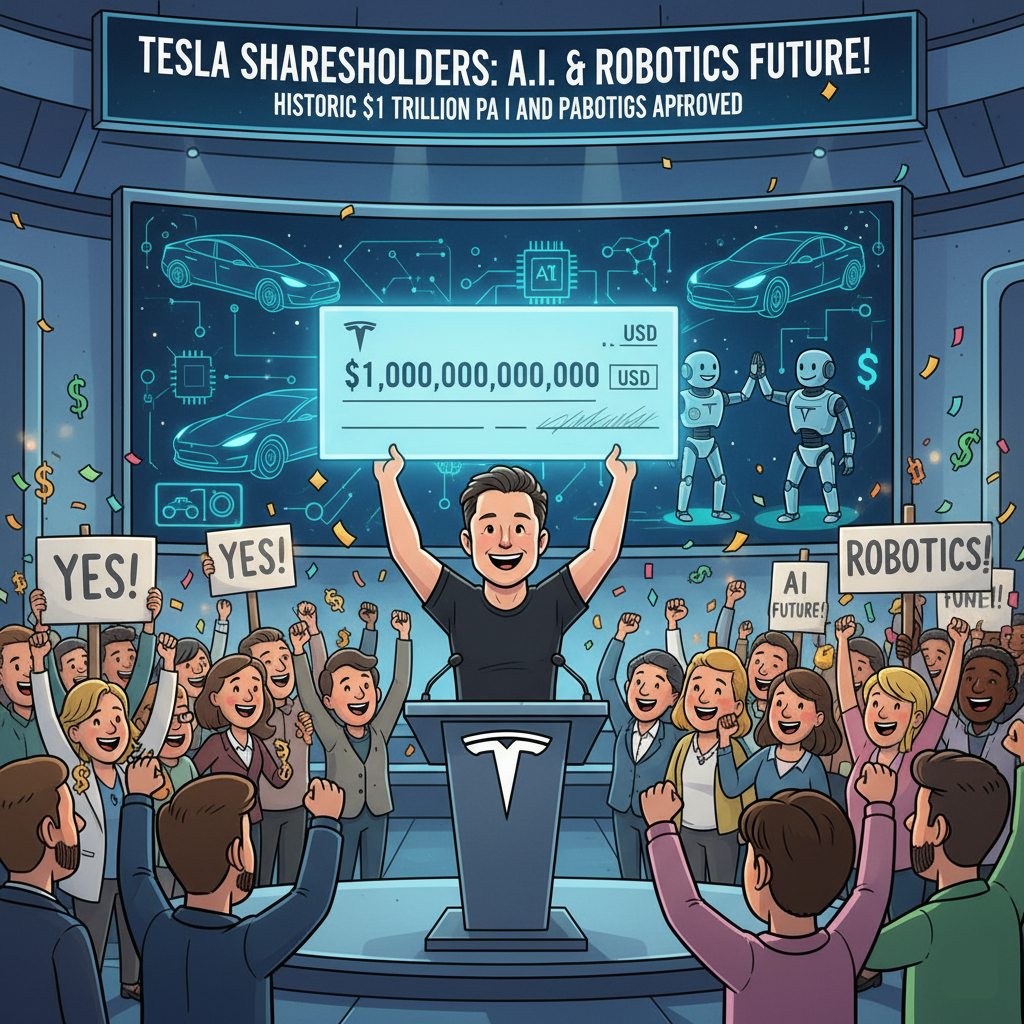
In the largest and most-watched corporate referendum in modern history, Tesla (TSLA) shareholders have voted to approve a monumental and controversial $1 trillion compensation package for CEO Elon Musk. The decision, announced at a raucous annual shareholder meeting on November 6, 2025, in Austin, Texas, saw over 75% of voting shareholders back the plan, tying the world’s richest person to the electric vehicle maker for the next decade with a set of goals so ambitious they aim to redefine not just the company, but multiple global industries.
This vote is far more than a simple payday; it’s a profound strategic gamble. It reinstates a plan once voided by a court, signals shareholder endorsement of Musk’s pivot from simply an EV maker to an AI and robotics juggernaut, and effectively silences critics who argued the largest pay package in corporate history was excessive. For Musk, who celebrated on stage with dancing Optimus robots, it was a moment of supreme validation. “It’s not just a new chapter for Tesla,” he told the cheering crowd, “it’s a new book.”
The Plan: A Trillion-Dollar Handshake Tied to Sci-Fi Milestones
The sheer scale of the 10-year compensation plan is difficult to comprehend. It is not a salary—Musk famously takes none. Instead, it is a 100% at-risk, performance-based stock grant broken into 12 tranches. To unlock the full package, which could be valued at just under $1 trillion (or $878 billion, depending on valuation at the time of vesting), Musk must achieve a series of goals that sound more like science fiction than a corporate filing.
The plan’s audacious targets include:
- Market Cap Growth: Expanding Tesla’s market capitalization from its current ~$1.5 trillion to an astronomical $8.5 trillion. This would be unlocked in $500 billion increments, each requiring a corresponding operational goal.
- Massive Vehicle Production: Delivering 20 million Tesla vehicles, a staggering figure that would eclipse the entire annual output of the world’s largest legacy automakers combined.
- The Robotaxi Fleet: Successfully deploying a fleet of 1 million autonomous robotaxis. This goal is central to Musk’s vision of Tesla as a service company, where cars generate revenue for their owners.
- The Optimus Workforce: Manufacturing and selling 1 million humanoid “Optimus” robots. Musk has repeatedly stated he believes the robotics business will ultimately be more valuable than the car business.
- Full Self-Driving (FSD) Dominance: Achieving 10 million active Full Self-Driving (FSD) subscriptions, turning Tesla’s software into a massive recurring revenue stream.
This is the largest executive compensation plan in history, dwarfing all others. By approving it, shareholders have essentially agreed to one of the biggest “all or nothing” bets in modern capitalism.
The Legal War and the Texas Two-Step
This historic vote was, in fact, a do-over. The package is a revised version of a $56 billion plan (valued at the time) that shareholders originally approved in 2018. However, in January 2024, a Delaware Chancery Court judge sensationally voided that package, siding with a single shareholder who argued the plan was “unfathomable” and that the board, under Musk’s influence, had failed in its fiduciary duty.
That ruling set the stage for a dramatic corporate maneuver. In response, Musk initiated a campaign to move Tesla’s state of incorporation from Delaware to Texas, a move shareholders also approved. With Tesla’s legal home now in the business-friendly Lone Star State, the board was free to re-introduce the compensation plan, effectively asking shareholders to ratify their 2018 decision and override the Delaware court’s objection.
The 2025 vote was a resounding success for the board, giving them the clear shareholder mandate they needed to insulate the new package from future legal challenges.
The Great Debate: Motivation vs. Madness
The run-up to the vote was fraught with intense debate, splitting the investment world.
The Case FOR the Package (The Board’s View): Tesla’s board, led by Chair Robyn Denholm, framed the vote as an existential necessity. Their argument was simple: Elon Musk’s focus is the single most valuable asset Tesla has.
With Musk’s sprawling empire now including SpaceX, X (formerly Twitter), the Boring Company, Neuralink, and his new AI startup, xAI, the board argued that this massive, performance-locked package was the only way to “retain Elon’s attention” and “motivate him to continue delivering superhuman results” at Tesla.
They argued that the “key person risk” was not Musk staying, but Musk leaving—or worse, diverting his best AI engineering talent to xAI. This plan, they argued, aligns his financial future inextricably with Tesla’s, ensuring he remains focused on achieving the AI and robotics vision that justifies Tesla’s lofty valuation.
The Case AGAINST the Package (The Critics’ View): A powerful bloc of institutional investors and advisory firms saw the plan as a colossal failure of corporate governance. Norges Bank Investment Management, which runs Norway’s $1.7 trillion sovereign wealth fund, and major proxy advisory firms like Glass Lewis and ISS all recommended voting against it.
Their arguments were clear:
- Excessive Dilution: The potential 12% stock grant would significantly dilute the value of shares for all other investors.
- Size is Absurd: The sheer size of the package was deemed “excessive” and “unprecedented,” bearing no relation to market norms.
- “Key Person Risk” Unsolved: Critics argued the plan doesn’t solve key-person risk. It gives Musk more power and wealth, which he could use to fund his other ventures, without any contractual obligation to dedicate a specific amount of time to Tesla.
- Motivation Not Needed: As Vermont Senator Bernie Sanders tweeted, it was “totally absurd,” asking why a man already the richest on Earth needed another trillion dollars as “motivation.”
Market Reaction and a “New Book” for Tesla
In a classic “buy the rumor, sell the news” event, Tesla’s stock (TSLA) fell nearly 5% in trading on Friday, November 7, 2025, the day after the approval. The market’s dip reflected the reality of the future stock dilution being priced in and the removal of the uncertainty that had surrounded the vote.
For Elon Musk, the vote was a triumphant, emotional vindication. The 75%+ approval was a clear mandate from his loyal retail investor base and a significant portion of institutional holders, who effectively told the board, “Musk is the asset. Pay the man.”
As he stood on stage, flanked by the very humanoid robots his pay package is contingent on building, his declaration of a “new book” for Tesla felt literal. The first book was the electric car revolution, a battle Tesla has decisively won. This new book, now funded by the largest incentive plan ever conceived, is about a far more complex and ambitious future: one where Tesla’s factories are filled with Optimus robots, its roads are filled with robotaxis, and its value is no longer tied to metal, but to intelligence.
Keywords: Elon Musk pay package, Tesla shareholder vote, $1 trillion compensation plan, Tesla AI robotics, Elon Musk $1T salary, Tesla Optimus, Tesla Robotaxi, TSLA stock, Tesla shareholder meeting 2025, Delaware court Tesla, Robyn Denholm.